
Live Dream Catcher Casino UK: What to Check
 Available in GB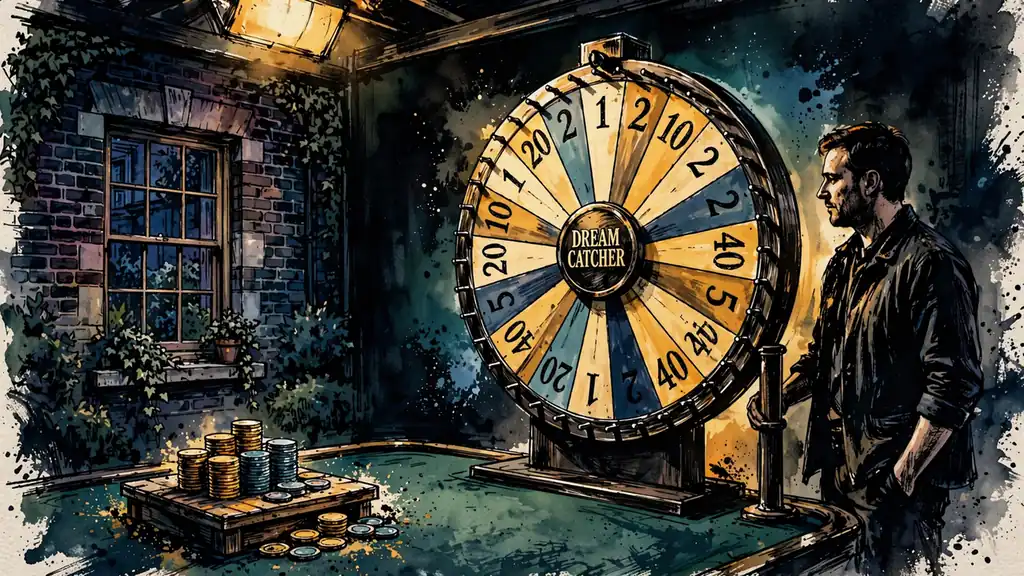
A practical guide to separating casino access from game availability and checking what can be verified about rules, demos and live play.
What “online casino” means for a live Dream Catcher game
An online casino is the remote gambling service through which casino content is made available over the internet. In a live-casino setting, that content is presented as a hosted game rather than as a purely digital simulation. The service may show a live studio feed, a table or game interface, wager controls, account functions and the result of each round in one online environment.
That distinction matters when the subject is Dream Catcher. The phrase “online casino” does not describe Dream Catcher itself. It describes the place through which a person might access a live version of the game, if that particular title is offered there. A reference to an online casino is therefore a reference to the operator and its casino service, not automatic proof that the named game appears in its lobby.
This is where promotional wording can blur two separate things. “Live casino” is a category of service. “Dream Catcher” is a particular product name. A casino can offer live content without offering every game associated with that category. Equally, a page discussing Dream Catcher can describe the route to an online casino without establishing that every operator carries the title. The label is not a catalogue.
American Roulette Online in the UK: Check the Operator
I have seen this separation matter in practice. Casino menus are assembled commercially, not according to every term used in a search. A site may promote live tables while its actual lobby contains a more limited selection. Games can be grouped under broad headings, placed behind a separate live-games tab, or shown only after an account has been created. A general live-casino page consequently says less than its headline may suggest.
The UK setting adds a clear legal boundary. Remote operators selling gambling to consumers in Great Britain must hold the relevant Gambling Commission licence, regardless of where their technical equipment is located. Online gambling is legal in the UK through licensed and regulated sites, and the Gambling Commission is the sole regulator for commercial gambling in Great Britain. That framework concerns the operator’s permission to provide remote gambling; it does not turn a licence into confirmation of any particular game.
The history of online live casino helps explain why the term is now familiar. Grosvenor first launched its live casino games in 2013, with card and casino offerings such as Blackjack, Texas Hold’em and Roulette. That example shows the structure clearly: an operator creates or provides an online live-casino service, then makes selected products available within it. The existence of the service and the contents of its game lobby remain related but distinct questions.
Live Roulette UK with English-Speaking Dealers
A live casino also differs from an ordinary casino game in presentation and operation. The interface may connect account wagering with a real-time broadcast, while the platform handles the practical parts behind the screen: opening the game, recording the wager, displaying the result and updating the account. None of that, by itself, identifies the rules or mechanics of Dream Catcher. It only explains what “live” means in the online-casino context.
The wording used around the subject should therefore be read precisely:
- A live online casino means an internet-based casino service featuring live-hosted content.
- An online casino offering Dream Catcher means a service that has specifically included that product in its available lobby.
- A Dream Catcher casino online is shorthand for the second idea, not a separate type of licence or gambling account.
- A live Dream Catcher casino in the UK combines the product name, the live format and the British market; it does not identify a particular operator unless one is named and its listing is confirmed.
That last point is especially important for expressions such as “the best online casino with Dream Catcher”. “Best” is not built into the words live casino or online casino. It is an assessment that would require evidence about a named operator, its licence, its current game listing and its terms. A broad category cannot supply that evidence on its own.
Nor should “play Dream Catcher online” be treated as a promise that access is available from every device or account. It describes an intended activity: joining an online service where the relevant product is actually presented. The practical route depends on the operator’s own lobby, account conditions and current offering. A search-friendly phrase can be wider than the service it describes.
The cleanest way to understand the subject is to keep three layers apart. First comes the regulated online casino as the access point. Second comes the live-casino section within that service. Third comes Dream Catcher as the named product, if it is listed there. Moving from one layer to the next requires confirmation; the name of the first layer does not prove the contents of the third.
Market
United Kingdom
Language
English
Subject
Dream Catcher
Category
Live Casino
That is the useful starting point. Separate the venue from the game.
Best casino sites in the UK
- Revery PlayBonus: 100% up to€1,000+ 100 FS · Payout speed: 1-3 business days
- NightWinBonus: £900 + 400 free spins · Payout speed: 1-3 business days
- WinBeastBonus: €5000 + 500 FS + €650 Freebet · Payout speed: 1-3 business days
- SpinFormulaBonus: 550% Up To £15,000 + 550 FS · Payout speed: 1-3 business days
- BritsinoBonus: Welcome Package – Get your £2,200 + 2,000 FS · Payout speed: 1-3 business days
- DieselwinBonus: Welcome Pack 250% up to £4000 + 200 FS · Payout speed: 1-3 business days
- x3betBonus: Welcome Pack 100% Up to £1.000 + 200 Free Spins · Payout speed: 1-3 business days
- SlotoSportBonus: 500% up to £ 10 200+ 777 FS · Payout speed: 1-3 business days
Dream Catcher in the live-casino context
Dream Catcher is best understood here as the name of a casino product associated with a live-casino search. That wording establishes the subject of the enquiry, but it does not establish where the game is offered, who operates it, how the session is conducted, or whether it is currently accessible to customers in Great Britain.
That distinction matters because a product name can travel further than the product itself. It may appear in casino navigation, promotional copy, comparison pages, archived material or user discussions without proving that a particular operator currently carries it. A familiar name is not the same thing as a confirmed lobby entry.
The phrase “live casino” also describes a setting rather than a complete specification. In ordinary industry use, it points towards a real-time casino presentation rather than a conventional computer-generated casino title. It may imply a streamed table, studio or host-led format, but the label alone does not establish the exact arrangement. Even when a casino groups a product under a live heading, the name and category still need to be checked against the operator’s current information.
I have seen how easily these distinctions disappear in commercial copy. A page may place a product name beside established live titles and leave the impression that every item has the same format, availability and operating conditions. That is presentation, not proof. The only safe conclusion from the name Dream Catcher is that it identifies the product being discussed.
The name is not a catalogue entry
A live Dream Catcher casino enquiry normally combines three separate ideas:
- the product called Dream Catcher;
- a casino offering live products;
- access for customers in the United Kingdom or Great Britain.
Those ideas overlap, but none automatically confirms the others. A casino can promote live games without carrying this particular product. A page can mention Dream Catcher without showing that the title remains available. A reference to the United Kingdom can describe an intended audience rather than demonstrate that the operator is authorised to serve customers in Great Britain.
That is why expressions such as “Dream Catcher casino UK” should be read as a request for a specific combination of product, operator and market access. They should not be treated as evidence that the combination exists at a named site.
The year attached to the enquiry creates another possible misunderstanding. A reference to 2026 signals that current availability matters. It does not turn older information into current information, and it does not confirm that a product’s presentation or distribution has remained unchanged. Live-casino pages can be revised, withdrawn or reorganised without the product name disappearing from third-party material.
What can be stated with care
Dream Catcher can be discussed as a live-casino product without assigning it details that have not been established. That means avoiding assumptions about its provider, studio, presenter, table format, betting layout, outcomes, return, volatility or operating schedule. Those are not decorative details. They determine what the product is and how it functions.
The same restraint applies to availability. It would be inaccurate to describe Dream Catcher as definitely offered by a particular British operator unless the operator’s own current service provides that confirmation. It would also be inaccurate to imply that a reference to a live casino guarantees access from Great Britain. The legal position of the operator and the actual presence of the product are separate questions.
The regulatory setting explains why the distinction is important. The UK Gambling Commission regulates online gambling and remote gambling offered to consumers in Great Britain, regardless of where the key equipment is located. Businesses offering that service need the relevant operating licence. However, the existence of that licensing framework does not by itself identify which individual live products appear in an operator’s lobby. Regulation concerns the operator’s authorisation and conduct; it is not a catalogue of every game available through the service.
European Roulette Casinos in the UK: What to Check
In practice, the product name therefore works as a starting point, not a conclusion. It identifies what needs to be located and checked. It does not supply the missing operational details.
A precise way to describe the subject
A careful description would be that Dream Catcher is the live-casino product under consideration, while its specific operation and availability must be established separately. This wording keeps the subject clear without turning an expression of interest into a factual claim about a particular casino.
It also prevents a common category error. “Live casino Dream Catcher” describes the intended destination of the enquiry; it does not prove that a live session is running, that a British customer can join it, or that every site using the product name presents the same service. The commercial label may be consistent while the practical access conditions differ between operators.
From my side of the counter, this was the useful dividing line: identify the product first, then separate naming from evidence. A title can be recognised before its mechanics, provider or availability are confirmed. That is not evasive wording. It is the difference between describing the subject and inventing a service around it.
Dream Catcher, then, belongs in the live-casino discussion as a product name whose context requires verification. The name makes the enquiry specific. It does not, on its own, make the product available, explain how it operates or establish that a particular UK casino supplies it.
How to assess a casino without an unsupported “best” claim
A label such as “best Dream Catcher casino” sounds precise, but it usually hides several separate judgements. Best for what: access to a particular live game, payment arrangements, customer support, complaint handling, safer-gambling controls, or the general range of casino products? Without a defined test and current evidence for each operator, the label is not a conclusion. It is advertising language.
DO
- Verify the operator’s Gambling Commission licence on the public register
- Check current game availability directly in the operator’s lobby
- Use account-level financial controls and responsible gambling tools
DON’T
- Assume a casino carries a game just because it is mentioned in promotional copy
- Treat “best” or “premium” as measurable performance indicators
- Apply slot-specific stake limits to other game types automatically
I have seen this distinction matter in practice. A casino can present an attractive live-casino page while leaving important conditions elsewhere on the site. Another operator may describe a broad product range without establishing that a particular game is available to every customer, at every time, or under every account condition. A ranking turns those unresolved points into apparent certainty.
The responsible approach is to assess the operator, not invent a league table for Dream Catcher.
Separate the game from the casino
A casino’s reputation does not prove anything specific about the operation of one game. The existence of live tables, a polished interface or a familiar brand name cannot, by itself, establish that Dream Catcher is offered there. Nor does a page that mentions the product necessarily settle whether it is currently accessible, available in the relevant jurisdiction, or subject to conditions that matter to a particular account.
That is why a general statement such as “this is the best place to play Dream Catcher” requires more than a brand description. It would need current, game-specific confirmation together with reliable information about the operator behind the site. Where that evidence is not available, the honest wording is narrower: the casino may be assessed on its published and verifiable characteristics, while the game’s availability remains a separate matter.
That separation is not pedantry. It prevents a general casino review from being presented as proof of a particular game offering.
Use checks that can be evidenced
A meaningful assessment can be built from information that an operator is expected to make clear. The useful categories are straightforward:
- the identity of the operating business;
- the relevant Gambling Commission licence information;
- the account and deposit conditions;
- the payment methods and restrictions applying to gambling;
- the procedure for complaints and access to Alternative Dispute Resolution;
- the responsible-gambling tools available within the account;
- the way age verification is handled before a deposit is allowed;
- the terms governing the live-casino service and any stated availability conditions.
These checks do not produce a universal winner. They show whether the site provides the information needed for an informed decision. That is a more defensible standard than arranging operators in a “top” list on the strength of design, promotional wording or an unexplained personal preference.
For remote gambling offered to customers in Great Britain, the relevant operator must hold the appropriate Gambling Commission licence. The Commission is the regulator for commercial gambling in Great Britain, and it issues operating licences to businesses as well as personal licences to individuals working in the sector. A casino assessment that ignores the legal status of the operator is incomplete before any discussion of games or interface begins.
Treat promotional language as a prompt to investigate
Words such as “premium”, “exclusive” and “best” describe positioning, not measurable performance. “Fast withdrawals” means little without clearly stated conditions and a reliable way to establish whether those conditions apply in the situation being considered. “Wide live selection” may describe the overall lobby while saying nothing about Dream Catcher.
I tend to translate each promotional claim into a question:
- What exactly is being claimed?
- Where is the supporting information?
- Does it apply to the operator, the live-casino section, or the named game?
- Is the information current and clear enough to check?
- Is an important condition placed somewhere else in the terms?
If the answer stops at a slogan, the claim should not become part of a ranking.
Avoid false precision
There is also a difference between a casino being suitable for a particular purpose and being objectively superior. One account holder may value payment choice; another may place more weight on support, account controls or the complaints route. Those preferences cannot be converted into a factual “best” result without assigning arbitrary importance to them.
The same caution applies to claims about safety or quality. A regulated operator still needs to be assessed through its published arrangements and current register information. Regulation is a threshold condition, not a reason to attach an unsupported rating to a game or casino.
Responsible gambling belongs in the assessment as well. A site should provide account-level financial controls and self-exclusion arrangements, but those tools do not turn wagering into a risk-free activity. Any decision must remain within money that can be afforded to lose.
No invented winner. That is the useful result.
Casino availability is not the same as game availability
A casino can advertise live gaming without offering every live product associated with that label. “Live casino” describes a broad area of an operator’s catalogue, not a promise that one named game will be present. The distinction matters when the intended product is Dream Catcher.
Casino Dice Games in the UK: How They Work
I have seen this confusion arise from a familiar chain of assumptions. A site displays live tables, studio footage or a section marked “live casino”, and the existence of that section is treated as evidence that Dream Catcher can be played there. It is not. The catalogue might contain card tables, roulette, game-show products or a mixture of these, while the particular title being sought is absent.
The reverse problem also occurs. A page may mention Dream Catcher in a promotional heading, an old article or a search result, yet that reference does not establish that the game is currently available after account access, regional filtering or product changes. A name appearing somewhere around a casino is not the same as a playable entry in its live lobby.
What needs to be confirmed
Availability has several separate parts:
- the operator serves the relevant market;
- the casino has a live-gaming area;
- Dream Catcher appears in the current catalogue;
- the title can be opened from the account’s jurisdiction;
- wagering is available rather than the page being an information or promotional listing.
Only the first two can be inferred from broad descriptions of a live casino, and even those should be checked against the operator’s current information. The presence of live games says nothing conclusive about the third point. A casino can have an extensive live selection and still not carry the particular product.
The wording used by operators also deserves care. “Live games” may refer to a category, while “featured games” may be a temporary display. “Available soon” is not current access. “Explore” may lead to an editorial page rather than a game lobby. In my own checks, the useful evidence is the product’s actual entry in the relevant catalogue, not a loose association between the operator and the live-casino market.
That is why a list of Dream Catcher casinos cannot responsibly be assembled from the fact that those businesses offer live gaming. Each claimed match requires a current, game-specific confirmation. Without it, the accurate description is narrower: the casino offers live products, but Dream Catcher availability remains unestablished.
There is another practical complication. Casino catalogues change. Games can be added, withdrawn, restricted by location or hidden behind an account login. A result that once pointed to a game may therefore describe an earlier arrangement. It should not be converted into a continuing claim.
The useful distinction is simple: casino availability concerns the operator’s live section; game availability concerns one named title at that operator, under the relevant access conditions. They are different checks. Almost opposite.
Online casino tournaments in the UK: formats and rules
Game rules, and the limits of what can be confirmed
Dream Catcher is often treated as if its name alone explains how the game works. It does not. A proper explanation of any casino game depends on its published rule set: the available wagers, the result procedure, the settlement of winning selections, and the treatment of special outcomes. Without those details, descriptions of how to play become speculation rather than guidance.
That matters particularly for a live-casino title. The word “live” describes the way the game is presented and operated, but it does not, by itself, establish the game’s category or its full betting structure. Nor does the word “casino” prove that the product should be analysed under the rules used for roulette, blackjack, or online slots. Those labels have different regulatory consequences, so attaching one without confirmation is poor practice.
I have seen game pages use familiar language to make an incomplete description sound definitive. “Simple” may mean that the interface has few visible controls; it does not explain how a result is generated. “Easy to play” may describe the layout rather than the underlying rules. The useful test is less flattering: can the published information show what each selection means, when wagering closes, how a winning result is settled, and whether any exceptional result changes the payment? If not, a responsible account should stop short of filling in the gaps.
Online Casino Games for Real Cash in the UK
The same discipline applies to outcomes. No particular result, return or advantage should be presented as a feature of Dream Catcher unless it is supported by the game’s own rules or another dependable record. General knowledge about casino games cannot be quietly transferred to this product. A wheel-based appearance, a live dealer presentation or a familiar interface would not be enough to establish the mathematics or the operation.
The stake-limit distinction
Great Britain’s online-slot limits should not be applied automatically. A specialist affiliate review reports a maximum of £5 for a single game cycle where the adult player is aged 25 or over, and £2 where the player is aged 18 to 24. That is a description attributed to that type of source, not a basis for classifying Dream Catcher.
The same source distinguishes those slot limits from roulette and blackjack: the stated online-slot caps do not apply to either of those games. That distinction is important, but it still does not place Dream Catcher in any category. Calling it a slot would require confirmation that it is regulated and operated as one; calling it roulette or blackjack would require a different, equally clear basis.
Consequently, “how to play Dream Catcher” should mean following the operator’s displayed instructions and the game’s stated rules, not importing rules from another product with a similar visual style. A careful description can identify the title and its live-casino setting while keeping unconfirmed mechanics, outcomes and classifications out of the account. Better incomplete than invented.
Live Casino Lightning Roulette in the UK
A wheel search does not establish the game’s mechanics
The word “wheel” creates a strong visual impression, but it is not a rules description. It may indicate how a game is presented on screen, how its results are displayed, or simply how people distinguish it from other live-casino products. On its own, it does not establish what the wheel contains or how a round operates.
That distinction matters with Dream Catcher. A page describing it as a wheel does not, by that label alone, confirm the segments, their values, the available wagers, the order of play, or the way a result is settled. It also does not establish whether the visible wheel is the complete game interface or only one part of the presentation. Those are separate matters.
From the operator side, I learned not to treat a familiar product description as a technical specification. Marketing language compresses several ideas into one convenient word. “Wheel” sounds precise because it names an object. In practice, it can leave the important mechanics unstated.
What the wheel description does not confirm
A wheel-based description does not, by itself, establish:
- the number or type of segments;
- whether every segment has the same function;
- which wagers are offered;
- how wager choices are displayed;
- how winning and losing outcomes are determined;
- whether a live presenter, an automated process, or another arrangement controls the round;
- how ties, special results, or unsettled wagers are handled.
None of those points should be filled in from another wheel game. Similar visual formats can use different rules, terminology and settlement procedures. Borrowing details from a familiar product may make an explanation sound complete while quietly turning assumption into fact.
The same caution applies when the wording includes “live casino”. That phrase places the subject in a live-casino setting, but it does not supply the game rules. Nor does it prove that a particular casino offers Dream Catcher, or that the product appears there in the form suggested by a description.
A reliable explanation therefore separates identification from operation. Dream Catcher can be referred to as a wheel-style live-casino subject without presenting unconfirmed details about its design. The proper next step is to rely on the game information displayed by the relevant operator or provider, where the segments, wagers and settlement terms are stated together.
The label is not the rulebook.
Checking a live casino site before depositing
A live-casino site serving customers in Great Britain falls under the UK Gambling Commission’s remote-gambling regime. The operator’s physical location does not change that requirement: the relevant point is that gambling is offered to consumers in Great Britain. The Commission is the regulator responsible for commercial gambling there, and it grants operating licences to businesses while issuing personal licences to people in relevant operating roles.
The first check is therefore the licence number, not a badge or a statement in promotional copy. It should be entered into the UK Gambling Commission’s public register before any deposit is made. The register should identify the operator and show that the licence covers the activity being offered. A site that cannot connect its legal business details to a current entry should not be treated as a licensed British casino.
The account controls matter as much as the licence. Before accepting a first deposit, a licensed operator must verify the customer’s age. New customers must also be prompted to set a financial limit before that deposit, with account-level controls available afterwards. Responsible-gambling tools, including self-exclusion, must be provided. GAMSTOP may also be relevant where broader self-exclusion is required.
Mines Casino Game UK: Demo Play and Risks
Payment wording deserves careful reading. UK-licensed casinos cannot accept credit cards for gambling, including credit-card funding routed through a money service business. A wallet cannot be used where its funds are sourced from a credit card for gambling. These restrictions apply even when the payment page presents the transaction as an ordinary wallet transfer.
The site should publish an internal complaints route and explain access to an approved Alternative Dispute Resolution service if the complaint is not resolved internally. Licensed operators also contribute to the Research, Education and Treatment levy, part of the wider regulatory framework.
I have found that the useful test is documentary rather than visual: licence entry, account controls, payment rules and complaints information should agree with one another. A polished live-casino interface proves none of those points. Any live Dream Catcher listing still requires separate confirmation from the operator; licensing alone does not establish that the game is available.
Demo searches: what can and cannot be verified
A request for a Dream Catcher demo is usually about trying the game without opening a gambling account or risking money. That is a different question from whether a casino carries a live game. A page may use the word “demo” while describing screenshots, a promotional video, a lobby preview or a play-for-fun version. Those are not interchangeable.
I have seen this wording create an avoidable assumption: a visible game tile is treated as proof that free play is available. It is not. A tile can lead to an account prompt, a sign-in screen, a real-money table or a general catalogue. Until the page actually opens a non-wagering session, the word “demo” describes an intention, not a confirmed function.
The same caution applies to a live-casino demo. Live products may depend on a streamed table, an active interface and operator-controlled access. A marketing page can present the title without offering a playable preview. It can also show a preview that does not reproduce the conditions of the live service. No invented claim about the table, wheel, segments, outcomes or betting controls belongs in a description of a supposed free version.
Does a live casino always have Dream Catcher?
No, a live casino refers to a category of service, and an operator may offer many live games without carrying this specific title.
How can I verify if a site is legal in the UK?
You should enter the operator’s licence number into the UK Gambling Commission’s public register.
What does a ‘demo’ version imply?
A demo might be a playable preview, but it can also simply be a promotional video or a screenshot that does not offer actual free play.
A genuine demonstration should make its status clear. Useful signals include a plainly labelled play-for-fun mode, an explanation of whether registration is needed, and a clear separation between simulated play and wagering. If the page moves straight to account creation, requests a deposit or displays wager controls, it should not be described as a demo simply because the game name appears.
There is also a practical limit to what a demo can prove. Free access, where offered, would show how the interface behaves; it would not establish that the same title is available for real-money play at every casino, nor would it justify a rating of the game. Availability must be stated only when the specific page provides that access.
“Free to try” needs proof.
A Dream Catcher review needs evidence, not a rating
A proper review of Dream Catcher has to describe the product itself, not borrow credibility from the casino displaying it. That means separating confirmed game information from promotional language and from assumptions based on the title.
A star rating cannot fill that gap. It gives an impression of precision while concealing which parts have actually been checked. I have seen ratings used as shorthand for “popular”, “exciting” or “worth trying”; none of those labels explains how the judgement was reached. “Best” is particularly weak unless it is tied to a stated measure and comparable evidence.
The same discipline applies when the subject is described as a live-casino experience. The word “live” should not be treated as proof of a particular studio, presenter, table format, broadcast arrangement or betting process. Those are product characteristics, not consequences of the name. They belong in a review only when the relevant information is clearly documented.
A casino review is a different piece of work. It may examine the operator’s licence, account conditions, payment arrangements, complaints route and safer-gambling controls. That does not establish whether Dream Catcher is available there, nor does it say anything reliable about the game’s quality. Conversely, a game review should not award Dream Catcher a rating merely because a named operator carries other live products.
The honest editorial treatment is therefore descriptive and conditional. Confirmed details can be reported plainly; unconfirmed features should not be reconstructed from similar products, advertising copy or assumptions about how a wheel or live game ought to work.
No rating. Just evidence.
Playing live: the final checks before joining
A live Dream Catcher listing should be treated as a current access question, not as a promise created by the game’s name. Search results, promotional pages and general references to live casino products do not by themselves show that a particular operator carries Dream Catcher or that a session can be joined from Great Britain. The practical point is simple: the game must appear within the operator’s own current offering, with the relevant joining and wagering conditions available before any funds are committed.
Age control comes first. A gambling operator must verify that a customer is at least 18 before allowing a deposit into a gambling account. That check is part of the account process, not an optional extra for a live table.
The same discipline applies to money. Live presentation can make a game feel immediate, but it does not change the underlying risk. Any wager should come only from money that can genuinely be afforded to lose. If losing the amount would affect rent, bills, food, borrowing or other essentials, joining the game is not a responsible decision.
I also regard a pause before funding as useful rather than inconvenient. It separates interest in playing from the decision to put money at risk. If the conditions are unclear, the game is not visibly listed, or the account checks have not been completed, there is no sound reason to proceed. A live interface creates atmosphere; it does not establish availability, suitability or a favourable outcome.
Are online casino games licensed and regulated?
Yes. Remote operators offering gambling to consumers in Great Britain must hold the relevant Gambling Commission licence, and the Commission regulates commercial gambling there.
What are the online slot stake limits in Great Britain?
The limit is £5 per game cycle for adults aged 25 and over and £2 for adults aged 18 to 24. These limits do not apply to roulette or blackjack.
Is LuckyPays licensed by the UK Gambling Commission?
The Commission’s public register dated 26 September 2026 does not show a LuckyPays entry under the brand or the stated domain luckypays.io.