
Non-GamStop Casino Mobile Experience
 Available in GB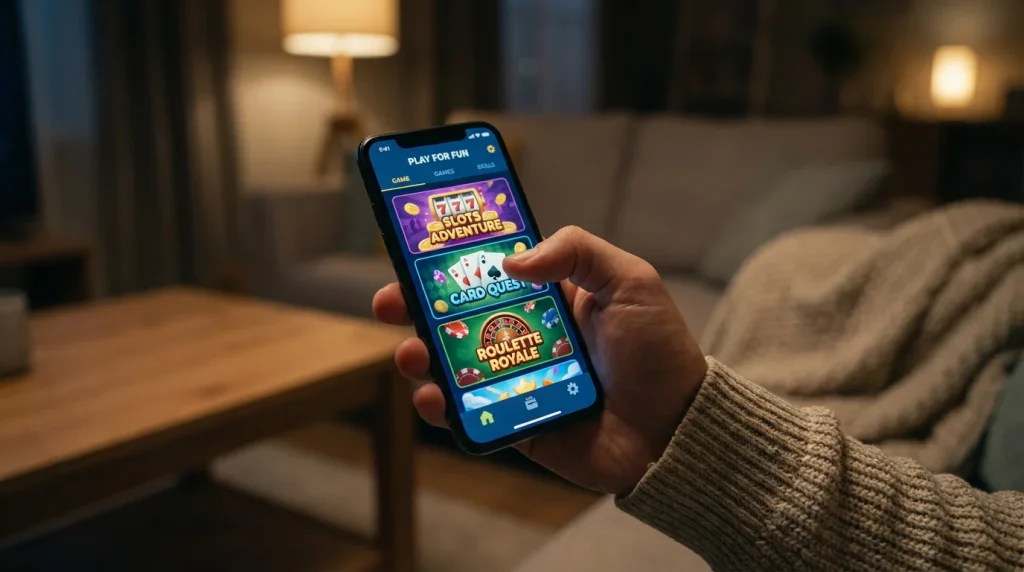
Mobile Gambling at Offshore Casinos
Most offshore casino sessions happen on mobile — and the UX gap with UKGC sites is narrowing. The era when non-GamStop casinos offered a degraded mobile experience compared to their UKGC-licensed counterparts is largely over. Competitive pressure, platform standardisation through white-label providers, and the universal shift of web development toward mobile-first design have raised the baseline quality of mobile gambling at offshore casinos to a level that, for the better platforms, is indistinguishable from regulated alternatives.
For UK players, this shift matters because mobile is where most gambling sessions now occur. Industry data consistently shows that over 70% of online gambling activity in the UK takes place on smartphones, and the pattern at offshore casinos mirrors this domestic trend. The practical implication is that the mobile experience isn’t a secondary consideration when evaluating a non-GamStop casino — it’s the primary interface through which most players interact with the platform, manage their accounts, and conduct transactions.
The quality of that mobile experience varies across the non-GamStop market. Some platforms deliver fast-loading, well-designed mobile interfaces with full feature parity to their desktop versions. Others offer functional but poorly optimised mobile sites that require excessive scrolling, suffer from slow loading, or lack features available on the desktop version. The difference between a good and a poor mobile experience compounds over every session — loading delays, navigation friction, and missing features accumulate into an experience that’s either seamless or frustrating.
Mobile-specific considerations also extend beyond the visual interface. Deposit flows that require multiple page loads on a small screen are cumbersome. Live chat windows that overlay the game and can’t be minimised are disruptive. Account settings that are accessible on desktop but hidden behind three menu levels on mobile create practical barriers to managing your own responsible gambling tools. The mobile experience encompasses every interaction with the platform, and evaluating it requires looking beyond the lobby’s visual polish to the functional depth underneath.
Understanding the technical approaches casinos use for mobile delivery, the performance benchmarks that distinguish a strong mobile platform from a weak one, and the features that enhance the mobile gambling experience helps you evaluate platforms before committing to one. The mobile interface is where you’ll spend your time. It should work like it was designed for the device in your hand, not resized for it as an afterthought.
Best casino sites in the UK
- Revery PlayBonus: 100% up to€1,000+ 100 FS · Payout speed: 1-3 business days
- NightWinBonus: £900 + 400 free spins · Payout speed: 1-3 business days
- WinBeastBonus: €5000 + 500 FS + €650 Freebet · Payout speed: 1-3 business days
- SpinFormulaBonus: 550% Up To £15,000 + 550 FS · Payout speed: 1-3 business days
- BritsinoBonus: Welcome Package – Get your £2,200 + 2,000 FS · Payout speed: 1-3 business days
- DieselwinBonus: Welcome Pack 250% up to £4000 + 200 FS · Payout speed: 1-3 business days
- x3betBonus: Welcome Pack 100% Up to £1.000 + 200 Free Spins · Payout speed: 1-3 business days
- SlotoSportBonus: 500% up to £ 10 200+ 777 FS · Payout speed: 1-3 business days
Mobile Browser vs Native App: How Offshore Casinos Deliver
Non-GamStop casinos deliver their mobile experience through one of three technical approaches: mobile-optimised browser sites, Progressive Web Apps (PWAs), and — more rarely — native mobile applications. Each approach carries different implications for performance, functionality, and accessibility.
Mobile-optimised browser sites are the dominant delivery method. The casino’s website is built with responsive design that adapts its layout, navigation, and game rendering to the screen size and capabilities of the device accessing it. You visit the casino’s URL in your phone’s browser (Safari on iOS, Chrome on Android), and the site presents a mobile-formatted interface without requiring any download or installation. This approach has the lowest barrier to entry — no app store approval, no download, no storage consumption — and it’s the method used by the vast majority of non-GamStop casinos.
The quality of mobile-responsive design varies. Well-implemented responsive sites adjust not just the layout but also the navigation structure, button sizing, text rendering, and image resolution for mobile screens. Poorly implemented ones simply shrink the desktop layout onto a smaller screen, producing tiny buttons, unreadable text, and horizontal scrolling that makes navigation frustrating. Testing the mobile experience before depositing — navigating the lobby, opening the cashier, accessing the support page — takes less than two minutes and reveals the quality of the responsive implementation immediately.
Progressive Web Apps (PWAs) are an increasingly common middle ground between browser sites and native apps. A PWA is a website that can be “installed” to your home screen, behaving like a native app — it launches in its own window (without the browser address bar), can send push notifications, and loads faster than a standard browser visit because it caches core assets locally. The casino remains a website underneath, but the user experience approaches that of a native app without requiring app store distribution. Several major non-GamStop casinos have adopted PWAs as their primary mobile delivery method, and the approach is gaining traction because it combines the accessibility of a browser site with the polish of an installed application.
Installing a PWA is straightforward: visit the casino’s mobile site, and look for an “Add to Home Screen” prompt or a banner suggesting installation. On Android, Chrome handles PWA installation natively. On iOS, Safari’s “Add to Home Screen” function achieves a similar result, though iOS imposes some limitations on PWA functionality (particularly around push notifications and background processing) that Android doesn’t.
Native mobile applications — standalone apps distributed through the App Store or Google Play — are uncommon at non-GamStop casinos. Apple and Google both enforce policies on real-money gambling apps that require the developer to hold a gambling licence in the jurisdictions where the app is available. This requirement effectively blocks most offshore casinos from app store distribution, since they don’t hold UKGC licences. Some non-GamStop casinos distribute Android APK files for direct installation outside the Play Store, bypassing Google’s review process. This works but requires the user to enable installation from unknown sources, which is a security consideration worth weighing.
Performance: Loading Times, Game Compatibility, and Touch Optimisation
Mobile performance at a non-GamStop casino is determined by three factors: the speed at which the platform loads and responds, the range of games that function properly on mobile devices, and the quality of touch-optimised controls within those games.
Loading time is the first and most noticeable performance indicator. A well-optimised mobile casino site loads its lobby within 2 to 3 seconds on a standard 4G connection. Games load within an additional 3 to 5 seconds. Anything consistently slower than this indicates an unoptimised platform — large image files, excessive JavaScript, uncompressed assets, or a server infrastructure that’s not geographically distributed to serve UK users efficiently. Slow loading isn’t just an annoyance; it directly affects the playing experience, particularly for session-based games like crash games and live dealer tables where connection speed matters for real-time interaction.
Game compatibility varies by provider and by game type. Modern HTML5-based games from major providers — Pragmatic Play, NetEnt, Evolution, Play’n GO, Nolimit City — are designed for cross-platform compatibility and function identically on mobile and desktop. Older Flash-based games, which still appear in some offshore lobbies, don’t work on mobile at all. Between these extremes, some games technically load on mobile but offer a degraded experience: small button targets, text that’s difficult to read, or bonus features that require precision tapping on elements designed for mouse cursors.
Live dealer games present specific mobile considerations. The video stream quality adapts to available bandwidth — dropping from HD to lower resolutions on slower connections — and the betting interface must accommodate touch interaction on a small screen while displaying the live video feed, the betting table, and the chat function simultaneously. Evolution’s mobile interface handles this well, with a stacked layout that prioritises the video stream and places betting controls below it. Other live providers vary in how effectively they manage the space constraints of a mobile screen.
Touch optimisation within games is the detail that separates a mobile-native experience from a desktop port. Well-optimised mobile slots feature large spin buttons positioned for comfortable thumb access, swipe gestures for navigating paylines and settings, and tap targets sized for fingertips rather than cursors. Table games should offer tap-to-bet with clear visual feedback, pinch-to-zoom on complex layouts, and controls that don’t require the precision of a mouse pointer. When a game hasn’t been optimised for touch, you notice it immediately — mis-tapped bets, accidentally triggered features, and the general sense that you’re wrestling with the interface rather than using it.
Mobile-Specific Features Worth Seeking Out
Beyond the base experience of loading games and placing bets, several mobile-specific features enhance the offshore casino experience on a phone or tablet. These features aren’t universal, but their presence signals a platform that’s invested in mobile as a primary delivery channel rather than an afterthought.
Biometric login — fingerprint or face recognition — replaces password entry with a one-touch authentication that’s both faster and more secure. At casinos that support it (typically through the mobile browser’s native biometric API or within a PWA), logging in takes under a second. The security improvement is real: biometric authentication eliminates the risk of shoulder-surfing and reduces the temptation to use simple, guessable passwords for quick access.
Push notifications, available through PWAs and native apps, alert you to bonus expiry, cashback credits, withdrawal completions, and promotional offers. The usefulness depends on the casino’s implementation — informative, low-frequency notifications about account activity are helpful; aggressive, high-frequency marketing notifications are intrusive. Most platforms allow you to configure notification preferences, and doing so at installation prevents the notification channel from becoming a spam vector.
Quick deposit from the mobile cashier — with saved payment methods and one-tap confirmation — reduces the friction of adding funds mid-session. The best implementations store your preferred payment method (with appropriate security) and require only an amount entry and a biometric confirmation to complete the deposit. The worst require re-entering card details or navigating a multi-step process that breaks the flow of play. Quick deposit is a convenience feature, but it’s also a spending accelerator — easier deposits mean less friction between the impulse to deposit and the action of doing so. Use the feature’s convenience, but be aware that it’s designed to reduce the pause that otherwise occurs when you need to find your wallet.
Landscape and portrait mode support for games determines how comfortably you can play in different physical positions. Most mobile slots work in both orientations, but some games — particularly live dealer tables with complex layouts — perform better in landscape. A casino that forces portrait mode for all games, or that doesn’t properly reflow the interface when you rotate your device, hasn’t finished its mobile optimisation.
If You Can’t Navigate It With One Thumb, It’s Not Mobile-Ready
The simplest test of a mobile casino’s quality is the one-thumb test. Can you navigate from the lobby to a game, place a bet, check your balance, access the cashier, and reach the support chat using only your thumb on a phone held in one hand? If the answer is yes, the platform was designed for mobile. If any of those actions requires two-handed operation, precision tapping, or excessive scrolling, the mobile experience is an adaptation of a desktop design rather than a purpose-built mobile interface.
Apply this test before depositing. Open the casino on your phone. Navigate the lobby. Open a game in demo mode if available. Check the cashier layout. Try to find the live chat. Access the responsible gambling settings and confirm they’re as functional on mobile as they are on desktop — deposit limits that are hard to find on mobile are deposit limits you won’t use. If the experience feels natural and the interface responds without friction, you’ve found a mobile-competent platform. If it feels like you’re using a desktop site on a small screen — because you are — factor that into your decision.
You’ll be using this interface for every session, and the cumulative friction of a poor mobile experience compounds into a reason to leave for a platform that respects the device in your hand. The mobile experience at the best non-GamStop casinos in 2026 is genuinely excellent — responsive, fast, feature-complete, and designed around the way people actually hold and use their phones. The experience at the worst is still a desktop afterthought crammed onto a small screen. The gap is wide, and it’s entirely avoidable with two minutes of pre-deposit testing. Your phone is where you’ll gamble. Make sure the casino was built for it.