
Blackjack Not on GamStop
 Available in GB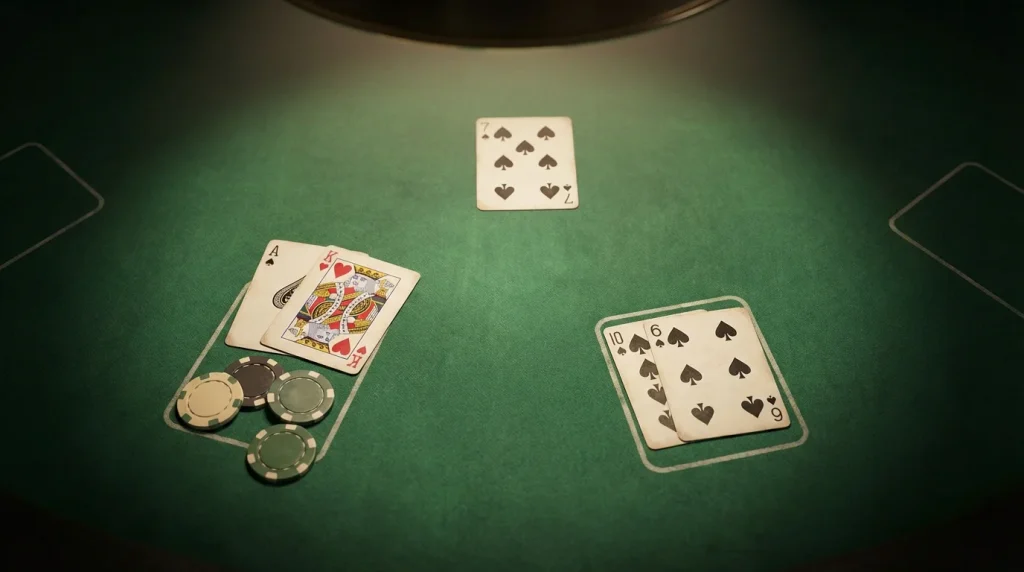
The One Casino Game Where Your Decisions Matter
Blackjack is the one game where your decisions actually affect the outcome — play it accordingly. In roulette, every bet carries the same house edge regardless of what you do. In slots, the RNG determines the result before the reels stop spinning. Blackjack is structurally different. Every hand presents a decision — hit, stand, double, split, surrender — and the mathematically correct choice varies depending on your cards and the dealer’s upcard. Make the right decisions consistently, and the house edge drops to roughly 0.5%. Make them poorly, and that edge climbs to 2% or higher. The gap between those two numbers, compounded over hundreds of hands, is the difference between a slow bleed and a haemorrhage.
At non-GamStop casinos, blackjack is available in every format: RNG-powered software versions, live dealer tables streamed from professional studios, and hybrid variants with automated dealing and live elements. The core game is identical to what you’d find at any UKGC-licensed platform — the same card values, the same objective of beating the dealer without exceeding 21, the same fundamental mathematics. What varies between platforms and between specific tables are the rule variations, and those variations matter more than most players realise.
The offshore blackjack landscape offers a wider range of rule configurations than UKGC-regulated sites. Some tables use rules that favour the player — early surrender, liberal doubling, 3:2 natural payouts. Others use configurations that inflate the house edge — 6:5 payouts on naturals, dealer hitting on soft 17, restrictions on doubling after splits. The difference between a player-friendly rule set and an unfavourable one can shift the house edge by a full percentage point or more, which over a session of 200 hands at £10 per hand translates to an additional £20 in expected loss.
Understanding these variations, knowing basic strategy, and choosing tables with favourable rules are the three things that separate an informed blackjack player from one who’s simply gambling on gut feeling. None of it guarantees you’ll win any given session — variance ensures that bad runs happen regardless of skill. But it guarantees that the mathematics are working as close to your favour as casino gambling permits. In a world where every game is designed to take your money, blackjack is the one that lets you argue back.
Best casino sites in the UK
- Revery PlayBonus: 100% up to€1,000+ 100 FS · Payout speed: 1-3 business days
- NightWinBonus: £900 + 400 free spins · Payout speed: 1-3 business days
- WinBeastBonus: €5000 + 500 FS + €650 Freebet · Payout speed: 1-3 business days
- SpinFormulaBonus: 550% Up To £15,000 + 550 FS · Payout speed: 1-3 business days
- BritsinoBonus: Welcome Package – Get your £2,200 + 2,000 FS · Payout speed: 1-3 business days
- DieselwinBonus: Welcome Pack 250% up to £4000 + 200 FS · Payout speed: 1-3 business days
- x3betBonus: Welcome Pack 100% Up to £1.000 + 200 Free Spins · Payout speed: 1-3 business days
- SlotoSportBonus: 500% up to £ 10 200+ 777 FS · Payout speed: 1-3 business days
Rule Variations That Shift the House Edge
The rules printed on the table felt — or displayed in the game’s info panel for RNG versions — are not cosmetic details. Each rule variation adjusts the house edge by a quantifiable amount, and the cumulative effect determines whether you’re playing a tight game or a loose one.
Dealer stands on soft 17 versus dealer hits on soft 17 is the most impactful single rule. When the dealer stands on all 17s (S17), the house edge is lower by approximately 0.2% compared to the hitting variant (H17). The reason is straightforward: a soft 17 (ace plus six) can improve to a higher total if the dealer hits, which increases the dealer’s chances of reaching 18 through 21 without busting. At non-GamStop casinos, both variants appear. Check before you sit down — the distinction is usually noted in the table rules or the game interface.
Payout ratios on a natural blackjack (an ace plus a ten-value card) vary between 3:2 and 6:5. This single rule change is the largest house edge modifier in the game. A 3:2 payout returns £15 on a £10 bet. A 6:5 payout returns £12 on the same bet. Over the long run, the 6:5 payout increases the house edge by roughly 1.4%, which is enormous in a game where the optimal edge is below 1%. Avoid 6:5 blackjack tables unless no 3:2 option exists. Some offshore casinos default to 6:5 payouts on certain tables — particularly single-deck games — without prominently advertising the fact.
Number of decks affects the house edge incrementally. A single-deck game with standard rules has the lowest base edge, but it’s frequently paired with 6:5 payouts to compensate. Six-deck and eight-deck shoes are the norm at most non-GamStop live tables, and they increase the house edge by approximately 0.5% to 0.6% compared to a theoretical single-deck game with identical rules. The deck count matters less than the payout ratio and the soft-17 rule, but it’s part of the equation.
Doubling rules vary. Some tables allow doubling on any two cards. Others restrict doubling to hard totals of 9, 10, and 11 only. Unrestricted doubling reduces the house edge by about 0.2% compared to the restricted version, because optimal strategy includes doubles on soft hands (ace-two through ace-seven) in certain situations. Doubling after splits (DAS) is another favourable rule — permitted at most offshore tables — that reduces the edge by roughly 0.15%.
Surrender, when available, is a powerful player option. Early surrender — offered before the dealer checks for blackjack — reduces the house edge by approximately 0.6%. Late surrender — offered after the dealer’s blackjack check — reduces it by about 0.08%. Early surrender is rare at any casino; late surrender appears more commonly at offshore platforms than at UKGC-regulated ones. The option to forfeit half your bet on unfavourable hands is mathematically valuable and should always be used when strategy dictates.
The cumulative effect of these rules determines the actual house edge at a specific table. A game with 3:2 payouts, S17, DAS permitted, and late surrender available might carry a house edge of 0.3% to 0.4% with perfect basic strategy. A game with 6:5 payouts, H17, no surrender, and restricted doubling might carry an edge above 2%. Both are called blackjack. They are not the same game.
Basic Strategy: The Only System That Actually Works
Basic strategy is a complete set of rules that tells you the mathematically optimal action for every possible combination of your hand and the dealer’s upcard. It’s derived from probability analysis — every scenario has been simulated across billions of hands, and the correct play for each has been determined with certainty. Following basic strategy perfectly doesn’t guarantee profit on any individual session, but it guarantees that you’re minimising the house’s mathematical advantage to its lowest possible level.
The strategy is presented as a grid. One axis lists your hand total (or specific card combination for pairs and soft hands). The other axis lists the dealer’s upcard (2 through ace). Each cell contains the optimal action: H (hit), S (stand), D (double if allowed, otherwise hit), Ds (double if allowed, otherwise stand), P (split), or Su (surrender if allowed, otherwise hit). The grid varies slightly depending on the specific rule set — the correct play in a few marginal situations changes between S17 and H17 games, or between DAS and no-DAS tables — but the core decisions remain consistent across most configurations.
Key decisions that players most frequently get wrong include standing on 12 against a dealer’s 2 or 3 (the correct play is to hit), hitting hard 16 against a dealer’s 10 (correct, despite the discomfort), splitting 8s against a dealer’s 10 (correct — two chances at 18 are better than one hand of 16), and never taking insurance (the insurance bet has a house edge of over 7% regardless of your hand). Each of these plays feels counterintuitive, which is precisely why they’re missed. Basic strategy often requires you to make the statistically correct decision against your emotional instinct, and that tension is where most players leak money.
Strategy cards — printed or digital reference charts — are permitted at virtually all online blackjack tables, including live dealer games at non-GamStop casinos. No dealer will object to you consulting a chart between hands. Using one eliminates memory as a variable and ensures every decision is optimal. There’s no advantage to memorising the chart unless you play frequently enough that the lookup time bothers you; the mathematical benefit is identical whether the correct play comes from memory or from a reference card on your desk.
One clarification worth making: basic strategy is not card counting. Card counting attempts to track the composition of the remaining shoe to identify moments when the odds temporarily favour the player. It’s a legitimate technique in live, physical blackjack, but it’s ineffective in online games where the shoe is shuffled after every hand (RNG) or where continuous shuffling machines are used at live tables. Basic strategy works regardless of shoe composition, shuffle frequency, or deck penetration. It’s always applicable, always optimal, and always free to use.
Side Bets: Entertainment at a Price
Side bets in blackjack are optional wagers placed alongside the main hand, and they’re available at most non-GamStop live dealer tables. The most common variants — Perfect Pairs, 21+3, and Insurance — share one characteristic: they all carry a significantly higher house edge than the main game, and none of them can be reduced through strategy.
Perfect Pairs pays when your first two cards form a pair. A mixed pair (same value, different suit and colour) pays 5:1 or 6:1. A coloured pair (same value and colour, different suit) pays 12:1 or 15:1. A perfect pair (identical cards) pays 25:1 or 30:1. The house edge on Perfect Pairs ranges from 4% to 8% depending on the paytable and the number of decks. Compare that to the 0.5% edge on the main hand with basic strategy, and the cost becomes apparent: a £5 Perfect Pairs bet costs you roughly ten to fifteen times more per pound wagered than a £5 main bet.
21+3 combines your first two cards with the dealer’s upcard to form a three-card poker hand. Flushes, straights, three of a kind, and suited trips each pay at different rates. The house edge sits between 3.2% and 7.5% depending on the specific paytable. It’s a more engaging side bet than Perfect Pairs because the outcome depends on three cards rather than two, but the mathematical cost is comparable.
Insurance is offered when the dealer shows an ace. It pays 2:1 if the dealer has blackjack. The bet’s house edge is approximately 7.4% in a six-deck game, making it one of the worst wagers available at the blackjack table. Basic strategy is unambiguous on this point: never take insurance. The exception — taking insurance when you hold blackjack yourself, sometimes called “even money” — is equally negative in expected value, despite the emotional appeal of locking in a guaranteed payout.
Side bets exist because they’re profitable for the casino and entertaining for the player. If you enjoy the additional action and treat the side bet as a separate entertainment expense with its own budget, that’s a personal choice. If you’re playing blackjack to minimise the house edge and extend your bankroll, every pound placed on a side bet is working against that objective at a rate five to fifteen times worse than your main wager.
Play the Math or Don’t Play at All
Basic strategy reduces the house edge to approximately 0.5% — ignore it and you’re donating. That’s not hyperbole. A player making decisions on instinct rather than strategy typically faces a house edge of 2% to 3%, depending on how far their gut diverges from the optimal play. On a session of 200 hands at £10 each, that’s the difference between an expected loss of £10 and an expected loss of £50. Over a month of regular play, the gap becomes hundreds of pounds — money lost not to bad luck, but to bad decisions that a free strategy chart would have corrected.
At non-GamStop casinos, the game is no different from any other blackjack table in the world. The cards don’t know the licence status of the platform. The mathematics are universal. What the offshore context offers is wider access to rule variants — some favourable, some not — and the absence of UKGC-mandated stake restrictions that might limit your bet sizing. Take advantage of the first by choosing tables with 3:2 payouts and player-friendly rules. Approach the second with the bankroll discipline that the regulatory framework no longer provides.
Download or print a basic strategy chart before your next session. Consult it for every hand until the correct plays become automatic. Avoid side bets unless you’ve budgeted separately for them and accept their cost as entertainment. Choose tables with 3:2 payouts, dealer stands on soft 17, and doubling after splits permitted. If the table doesn’t display its rules clearly, ask the dealer or check the game info — any table hiding its rules isn’t one you want to sit at.
Blackjack rewards preparation. It’s the only casino game that does. Respect that, and the game will cost you less than any other table in the house. Ignore it, and you’re paying a premium for the privilege of guessing.